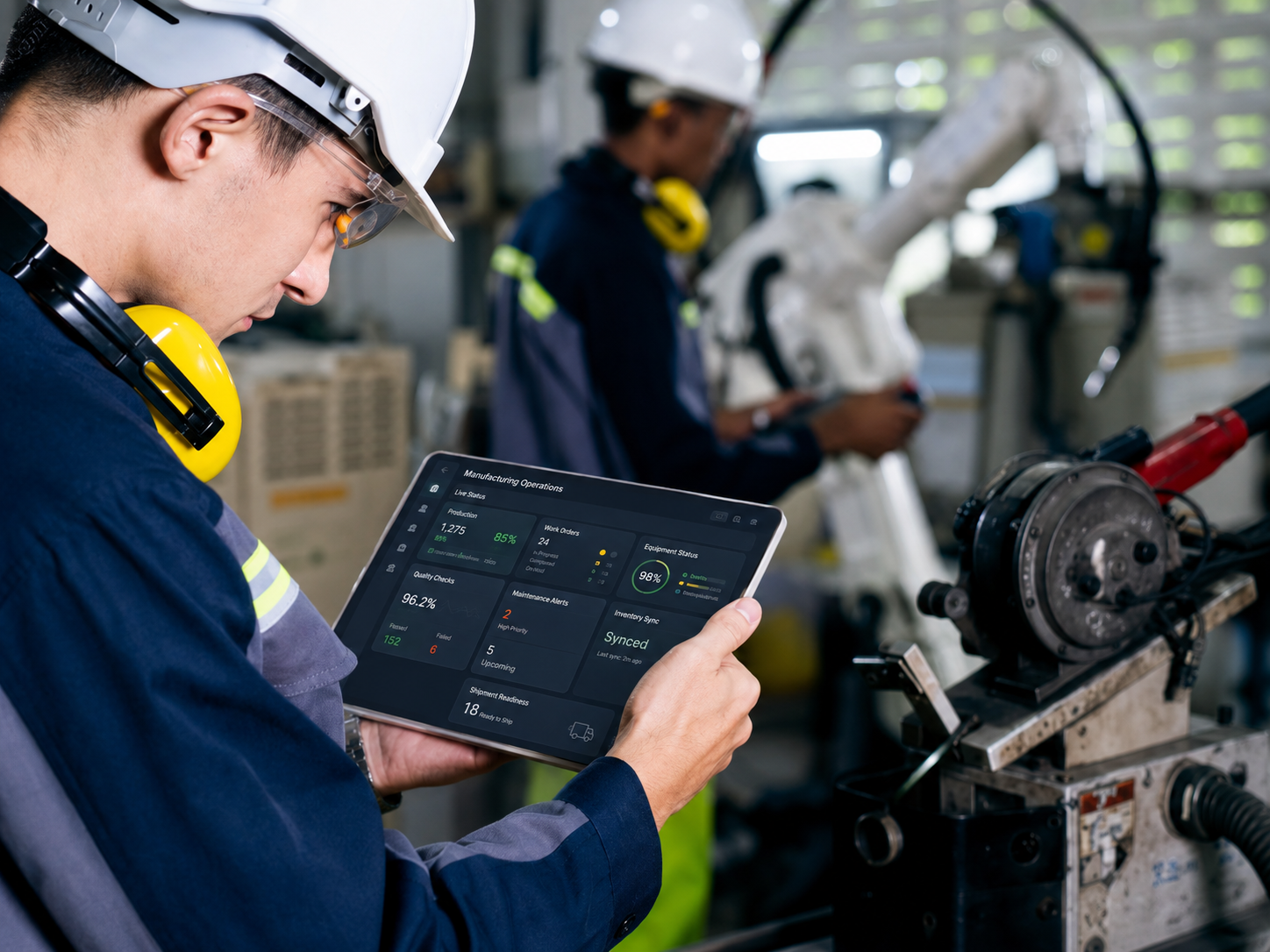


Improve digital manufacturing with connected operations, real-time data, and fewer manual process handoffs.
A production line can be running at 92% of target, a quality team can be closing defects on time, and the ERP can still show yesterday’s inventory position. Manufacturers have added software for years. MES, ERP, maintenance platforms, warehouse tools, quality systems, spreadsheets, machine dashboards, supplier portals, and custom databases all have a job. That is where manufacturing operations solutions need a rethink.
Modernization is not about putting another dashboard above the same disconnected processes. It is about making production information move with the work, so planners, supervisors, maintenance teams, quality staff, and finance are not operating from different versions of the day.
For firms pursuing digital manufacturing, the strongest starting point is usually a boring one: follow one order from release to shipment and write down every manual handoff. The waste shows up quickly.
Why Manufacturing Operation Solutions Need To Start With The Plant Floor
Good manufacturing operation solutions start there. They connect the systems already involved in production before adding new layers that staff must maintain.
UNIDO’s World Manufacturing Production and Trade Report in Q1 2026 said global manufacturing production rose 1.2% quarter over quarter, with medium-high and high-technology industries continuing to lead lower-tech sectors. That growth puts more pressure on plants to coordinate equipment, data, suppliers, and production decisions without adding another manual reporting chain.
Two early questions usually expose the biggest gaps:
- Where does a supervisor still need to call, message, or walk across the plant to verify a status?
- Which production number is copied into another system before someone can act on it?
What Manufacturing Operations Modernization Actually Covers
Manufacturing operations solutions should cover the full route from demand to production, not only machine connectivity. That includes order release, capacity planning, material availability, work instructions, downtime, maintenance, quality, traceability, labor reporting, warehouse movement, and shipment confirmation.
Connect ERP, MES, Quality, Maintenance, And Warehouse Data
A plant may have every major system in place and still run on reconciliation. ERP says an order is released. MES says it is waiting. Maintenance has an open work order. Quality has put a lot on hold. The warehouse has already moved material.
Production data integration is valuable when those events can update each other without a person acting as middleware.
This modernization plan should define one owner for each core data object. The production order may originate in ERP, machine state on the line, and quality status in QMS. Each system can keep its job while downstream tools receive current information through controlled connections.
Teams reviewing that foundation can also use our security services to see how Hubops approaches access control, application protection, API security, infrastructure security, and data protection across connected environments.
Keep Operators Inside The Flow
If an operator has to open three screens to record one stoppage, the data will be late. If a maintenance technician must re-enter an asset number that already exists in the machine event, the workflow is wasting time. If quality approvals happen in email, traceability becomes harder when a customer complaint arrives six months later.
Digital manufacturing should reduce these steps. The new workflow can prefill known fields, route exceptions, trigger approvals, and keep human judgment where it belongs.
Build Manufacturing Operation Solutions Around Production Exceptions
Most plants do not need more alerts. They need fewer alerts that tell the right person what to do next.
A modern operating flow can treat exceptions differently. A short stoppage may only update OEE. A repeated stoppage on the same asset may create a maintenance inspection. A quality deviation may block release of the affected batch. A late inbound component may trigger a schedule review before the line runs short.
Our approach to digital trust gives a broader view of how Hubops approaches transparency, reliability, data control, responsible AI, and vendor accountability. Those controls become important when automated factory decisions rely on data coming from several systems.
Digital Manufacturing Needs Better Scheduling, Not Just Better Dashboards
A planner does not need a prettier production chart if the schedule still ignores tooling, maintenance windows, labor limits, material shortages, and actual cycle time.
The scheduling layer should respond to current conditions without rescheduling the whole plant every five minutes. Constant changes can create more disruption than the original delay.
The WTO’s Global Trade Outlook and Statistics baseline, published in March 2026, projected world merchandise trade volume growth of 1.9% in 2026 and 2.6% in 2027. The same outlook warned that higher energy prices could cut the 2026 trade forecast. Plants handling imported components or export orders therefore need manufacturing operation solutions that can react to supply and logistics changes without turning every disruption into a spreadsheet exercise.
Predictive Maintenance Works Only When The Workflow Is Ready
The maintenance workflow should connect condition data with work orders, parts, production schedules, and maintenance history. Otherwise, predictive maintenance becomes another screen technicians are expected to watch.
Start With Repeat Failures
For each asset, capture failure mode, signal source, response owner, required lead time, spare requirement, and proof that the intervention worked. That creates a usable operating loop before advanced models enter the picture.
Our operations and technology articles can be a useful place for operations leaders reviewing modernization topics across connected systems, automation, data, and application change. The point is to bring technology decisions back to how work actually moves.
CTA: Are Production Systems Still Making Teams Chase The Same Update?
Connect manufacturing operation solutions with Hubops to reduce manual handoffs, improve plant visibility, and modernize workflows without interrupting live production.
Quality And Traceability Should Move With Production
Quality data often arrives one step late. The line produces. The inspection records a problem. Someone then checks which batch, machine setting, operator, supplier lot, and work instruction were involved.
Manufacturing operation solutions can tighten that chain by linking production events with inspection results and material genealogy as the work happens.
A useful traceability record should answer four questions quickly: what was made, which inputs were used, which process conditions applied, and who approved release. UNIDO’s World Manufacturing Production and Trade Report for Q4 2025 found global manufacturing exports rose 1.7% quarter over quarter, while higher-technology exports increased 2.6%. More cross-border movement means more documentation, supplier evidence, product history, and change control traveling with manufactured goods.
Manufacturing Operation Solutions Need One Approach To Plant Data
Manufacturing operation solutions need a data model that is strict enough for comparison but flexible enough for plant differences.
Standardize What Must Be Shared
Start with common definitions for asset, order, product, batch, shift, downtime reason, quality status, maintenance event, and material movement. Then decide which fields are global and which stay plant-specific.
For teams looking at how operational modernization is being discussed across architecture, automation, and data foundations, our research-backed whitepapers provide material from the Hubops team without tying the decision to one software product.
Energy Data Belongs Inside Manufacturing Operations Modernization
Manufacturing operations solutions can bring energy data closer to production data. A plant may learn that one product family needs an extra heating cycle, one compressed-air leak appears only during a certain shift, or an idle line still carries a high base load.
The IEA’s Energy Efficiency 2025 report says industry accounts for nearly 40% of global final energy demand and contributed about two-thirds of the increase in global final energy demand since 2019. That gives factories a strong reason to connect energy monitoring with operating decisions rather than treating it as a utility-bill review.
Useful energy-linked production measures include:
- energy consumed per good unit, with scrap separated rather than hidden in the denominator
- idle, startup, changeover, and production energy shown as different operating states
Digital manufacturing becomes more useful when teams can see whether a process change improves throughput while quietly increasing energy or scrap.
Security Has To Follow OT And IT Connectivity
Connecting more equipment creates more routes into the production environment. That does not mean factories should avoid connectivity. It means manufacturing operation solutions need access controls, network boundaries, device ownership, patch planning, backup recovery, and vendor access rules designed alongside the workflow.
The security review should include the data path too. If a machine event moves into a cloud analytics tool, then into a maintenance platform, teams need to know which identities and connectors can change or read that information.
How To Modernize Without Stopping Production
Manufacturing operation solutions should be introduced in a sequence that respects the production calendar.
Start with a line, asset group, or workflow where the current failure is obvious. Build the integration. Run it alongside the existing process. Compare results. Test what happens when a system is unavailable. Give supervisors and operators a way to report friction before scaling.
Use A Controlled Plant Rollout
A phased rollout can follow four steps: baseline the current process, connect the minimum data needed, run in shadow mode, then move ownership to the new workflow once the numbers match.
One point we see repeatedly at Hubops is that manufacturing operation solutions gain support faster when the first project removes a task people already dislike. Automating a manual production-status report can do more for adoption than launching a large portal nobody asked for.
Measure Manufacturing Operation Solutions Through Daily Work
Track schedule adherence, unplanned downtime, mean time to repair, first-pass yield, scrap, changeover time, production reporting delay, maintenance response time, inventory accuracy, and exception closure.
Manufacturing operation solutions should also measure how often people leave the new flow. If staff still export data to personal spreadsheets, send screenshots in chat, or call another department for a status that should be visible, the process is not finished.
CTA: Ready To Modernize Factory Operations Without A Big-Bang Reset?
Work with Hubops to connect manufacturing operation solutions across production, maintenance, quality, and data while keeping active plants running through each phase.
How Hubops Supports Manufacturing Operations Modernization
At Hubops, we approach manufacturing operation solutions from the operating flow outward. We look at what starts a process, where data is created, which system owns it, who needs the next update, and what happens when the normal route breaks.
For digital manufacturing, the practical goal is a connected operating environment where teams spend less time reconciling information and more time dealing with production itself. The technology should help supervisors act sooner, maintenance teams plan better, quality teams trace faster, and leaders compare performance without waiting for someone to rebuild the numbers.
Final Thoughts
The better question is whether manufacturing operations solutions make a shift easier to run. Can a planner see a shortage before it reaches the line? Can maintenance act on a condition alert with the right production context? Can quality trace a problem without searching four systems? Can management trust the same output number the supervisor sees? If those answers improve, modernization is doing useful work.
Hubops helps manufacturers move toward that kind of operating model in controlled steps. A rollout also gives plant leaders evidence they can use when deciding whether the next investment should target capacity, quality, maintenance, or labor. The goal is fewer workarounds, cleaner plant data, faster exception handling, and digital manufacturing that teams can actually use during a busy shift.
FAQs
What are manufacturing operation solutions?
They connect production, maintenance, quality, inventory, scheduling, and data workflows so plant teams can act faster.
Where should a manufacturer start modernization?
Start with one costly workflow involving repeated manual updates, production delays, downtime, scrap, or poor visibility.
How does digital manufacturing improve plant operations?
It connects machine and business data so teams can respond to production events with current information.
Can old factory systems be modernized without replacement?
Yes. Stable systems can stay while integrations, data flows, security, and user workflows are improved around them.
Which metrics show manufacturing modernization is working?
Track downtime, schedule adherence, first-pass yield, scrap, response time, reporting delay, and workflow adoption.