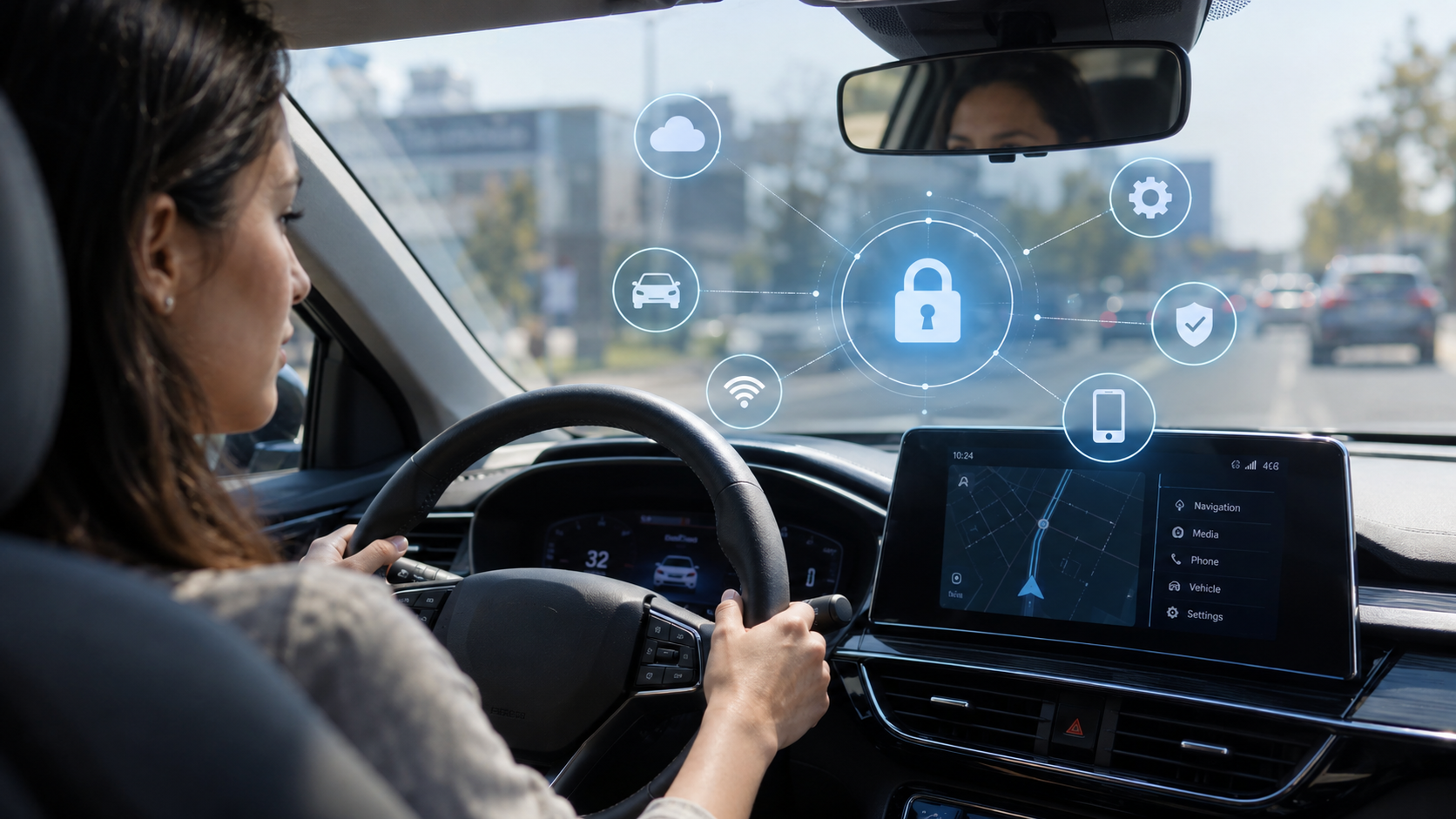


Every connected feature opens a new path for data, updates, access, and automotive cyber risk.
A connected car is no longer only a vehicle with a screen, GPS, and Bluetooth. It is a rolling software system with sensors, cloud calls, mobile apps, payment data, driver profiles, OTA updates, and supplier code moving through it. That makes the promise bigger. It also makes the risk less forgiving.
This is why cyber automotive solutions now belong in the first planning meeting, not after launch. A weak mobile app can open a door. A rushed OTA update can push faulty code to thousands of vehicles. A poorly checked supplier library can follow the vehicle through production, service, and resale. Automotive security has moved from the IT room to the steering wheel.
The warning signs are already public. The UK Government’s Cyber Security Breaches Survey 2025 said 43% of businesses reported a cyber breach or attack in the previous 12 months, while the figure reached 67% for medium businesses and 74% for large businesses. Vehicle companies, dealer groups, fleet operators, and mobility platforms do not work outside that risk. They live inside it, with more connected endpoints than most teams are used to managing.
Why Cyber Automotive Solutions Start Before The First Drive
The usual mistake is to treat vehicle cybersecurity as a final hardening job. That is too late. By then, APIs are live, app permissions are broad, supplier access is messy, logs are thin, and teams are under release pressure.
Good cyber automotive solutions begin with architecture. Who can reach the vehicle? Which services can change software behavior? Which cloud systems store trip history? Which vendor can touch diagnostic data? Which alerts tell us if a pattern looks wrong?
For connected vehicle teams, the first security review should cover:
- Vehicle app permissions, API authentication, OTA update approval, and telematics data access.
- Supplier code review, encrypted communication, identity controls, incident playbooks, and audit logs.
This is also where automotive software solutions fit naturally. At Hubops, we look at the vehicle, cloud, data, and workflow together because automotive security breaks when these parts are managed as separate jobs.
Automotive Security Risks Inside Connected Vehicle Platforms
A connected vehicle platform usually has more attack paths than leaders expect. Mobile apps, cloud services, diagnostics tools, dealers, insurers, fleet managers, and support teams may all need access. That is useful, but every connection needs a rule, an owner, and a record.
API And App Weaknesses
Many user journeys start on a phone: lock, unlock, locate, pay, update, book service, check battery, or share access. If the app uses weak authentication or exposed APIs, the vehicle becomes part of the app’s risk.
Cyber automotive solutions should test the app like a product and like a control surface. That means token review, rate limits, device binding, abuse testing, and careful treatment of location data.
OTA Update And Firmware Exposure
OTA updates help automakers fix problems faster. They also create a trust question. Who signs the update? Who approves it? Can the vehicle roll back safely?
Reuters reported in February 2025 that China made autonomous-driving related OTA upgrades subject to regulatory approvals, partly to stop automakers from using updates to hide defects or avoid liability. That is a useful signal for every market. Software changes in vehicles now carry safety, legal, and cybersecurity consequences at once.
Telematics And Driver Data
Telematics data can improve maintenance, insurance, logistics, and customer service. It can also expose routes, habits, charging behavior, service history, and personal identifiers. Automotive security, therefore, needs data minimization, retention rules, consent tracking, encryption, and clean access records. When teams plan AI, analytics, or mobility apps around connected data, our view of security, data sovereignty, and AI readiness gives a useful path for keeping controls close to the workflow.
Cyber Automotive Solutions For Software-Defined Vehicles
Software-defined vehicles push more functions into code. That helps brands ship features after the sale. It also means defects, misconfigurations, and bad dependencies can travel fast.
The U.S. The risks highlighted in the Federal Register rule “Securing the Information and Communications Technology and Services Supply Chain: Connected Vehicles,” published on January 16, 2025, include sensor manipulation, data capture, and unauthorized control via compromised autonomous driving software. It also establishes future timelines for when software bans will go into effect in model year 2027 and hardware bans in model year 2030.
As an OEM and/or supplier, cyber automotive solutions should contain:
- Safe software development for connected apps, backend systems and vehicles.
- Dependency scanning, SBOM reviews, key management, signed updates, and supplier access reviews.
Some teams also need tamper-resistant records for parts provenance, service events, warranty claims, or update approvals. Hubops can support this through blockchain development services, where traceability and verified events are part of the operating need.
Automotive Security Compliance Is Becoming A Board-Level Topic
Connected vehicle regulation is moving faster than many delivery plans. In the EU, the Cyber Resilience Act sets cybersecurity requirements for products with digital elements. The European Commission says reporting obligations apply from 11 September 2026, with early warnings due within 24 hours and full notifications within 72 hours for actively exploited vulnerabilities or severe incidents. Main obligations apply from 11 December 2027.
That timeline affects more than European product teams. Global automotive businesses reuse platforms, components, cloud services, and suppliers across regions, so one strict market can reshape the full program.
India is moving too. Economic Times reported on July 5, 2026, that proposed rules would make cybersecurity and software update management mandatory for advanced vehicles, including passenger and commercial vehicles with Level-3 or higher automated capability. The same report said OTA-capable vehicles are expected to come into scope in later phases.
For leaders, the question is no longer, “Can we pass an audit?” It is, “Can our security model survive growth, patch cycles, suppliers, connected apps, and new laws without slowing every release?”
CTA: Need Cyber Automotive Solutions Built Around Safer Mobility?
Build connected vehicle platforms with Hubops to protect software updates, vehicle data, cloud access, and supplier workflows before risk reaches the driver.
Where Connected Vehicle Security Usually Breaks
I have seen teams spend weeks arguing over tools while the actual risk sat in workflow gaps. Nobody owned failed update retries. Nobody reviewed vendor support accounts. No one knew which cloud logs would prove what happened during an incident.
Identity, Access, And Monitoring
Vehicle ecosystems depend on diagnostics providers, cloud teams, app developers, data partners, dealers, fleet operators, and roadside support. If access stays broad, old, or poorly logged, attackers do not need a clever vehicle hack. They need one weak account.
Automotive security should use least privilege, strong MFA, short-lived tokens, role reviews, quick offboarding, and visible emergency access records.
A suspicious event may not start inside the vehicle. It may show first as unusual API traffic, abnormal app behavior, repeated failed commands, strange OTA retries, or unexpected access from a support account.
That is why cyber automotive solutions should connect signals from apps, backend services, fleet dashboards, and update pipelines. The ENISA Threat Landscape 2025 reviewed 4,875 incidents from 1 July 2024 to 30 June 2025, showing how active the security environment remains across sectors.
Hubops also connects this need with a safer network change. Our guidance on AI-driven network modernization is useful when teams need better visibility, tested rollout plans, and stronger response without risking uptime.
How Hubops Builds Cyber Automotive Solutions For Connected Mobility
At Hubops, we do not treat cybersecurity as a bolt-on layer. We work from the operating path. Where does the vehicle data start? Which cloud services process it? Which teams can act on it? Which suppliers touch the stack? Which systems need proof during an investigation?
That review shapes the security plan. In some projects, the priority is API hardening and app testing. In others, it is OTA governance, supplier controls, data residency, or security monitoring.
Our work on cyber automotive solutions usually focuses on:
- Building secure connected vehicle platforms with stronger identity, logging, encryption, and access design.
- Reducing risk across OTA updates, telematics pipelines, fleet dashboards, service tools, and third-party integrations.
The goal is safer mobility with fewer surprises after release.
CTA: Want Connected Vehicle Security Without Slowing Delivery?
Plan cyber automotive solutions with Hubops to secure apps, OTA updates, telematics data, supplier access, and compliance workflows as one connected program.
Final Thoughts
Connected vehicles are changing how people drive, insure, repair, and manage mobility. A vehicle now depends on software, cloud services, suppliers, devices, updates, and data flows that keep changing after sale.
That is why cyber automotive solutions must be built early and reviewed often. Automotive security is product safety, customer trust, regulatory readiness, and operating continuity. At Hubops, we build that protection around how connected mobility actually runs, from code to cloud to driver.
FAQs
What are the most serious cybersecurity issues in the Internet of Vehicles?
The core issues are low-quality APIs, unreliable OTA distribution updates, insecure telematics data, access limitations from suppliers, and inadequate monitoring of cloud and vehicle systems.
What is the rationale behind the demand for connected vehicles' cyber automotive solutions?
With the software, apps, sensors, cloud platforms, and data services come many avenues for misuse or disruption that require a cyber automotive solution.
What impact does automotive security have on OTA updates?
Automotive security ensures OTA updates are code-signed, approved, rollback-planned, validated, and monitored for failed or suspicious update activity.
What are some things OEMs should do before releasing connected vehicle features?
OEMs should look at app security, API access, data storage, vendor permissions, OTA controls, incident response, compliance requirements, and customer data consent.
What does Hubops have to offer for connected vehicle cybersecurity?
Hubops can audit the connected vehicle stack, protect critical workflows, enhance access control, safeguard data flows, and create a safer release and monitoring strategy.