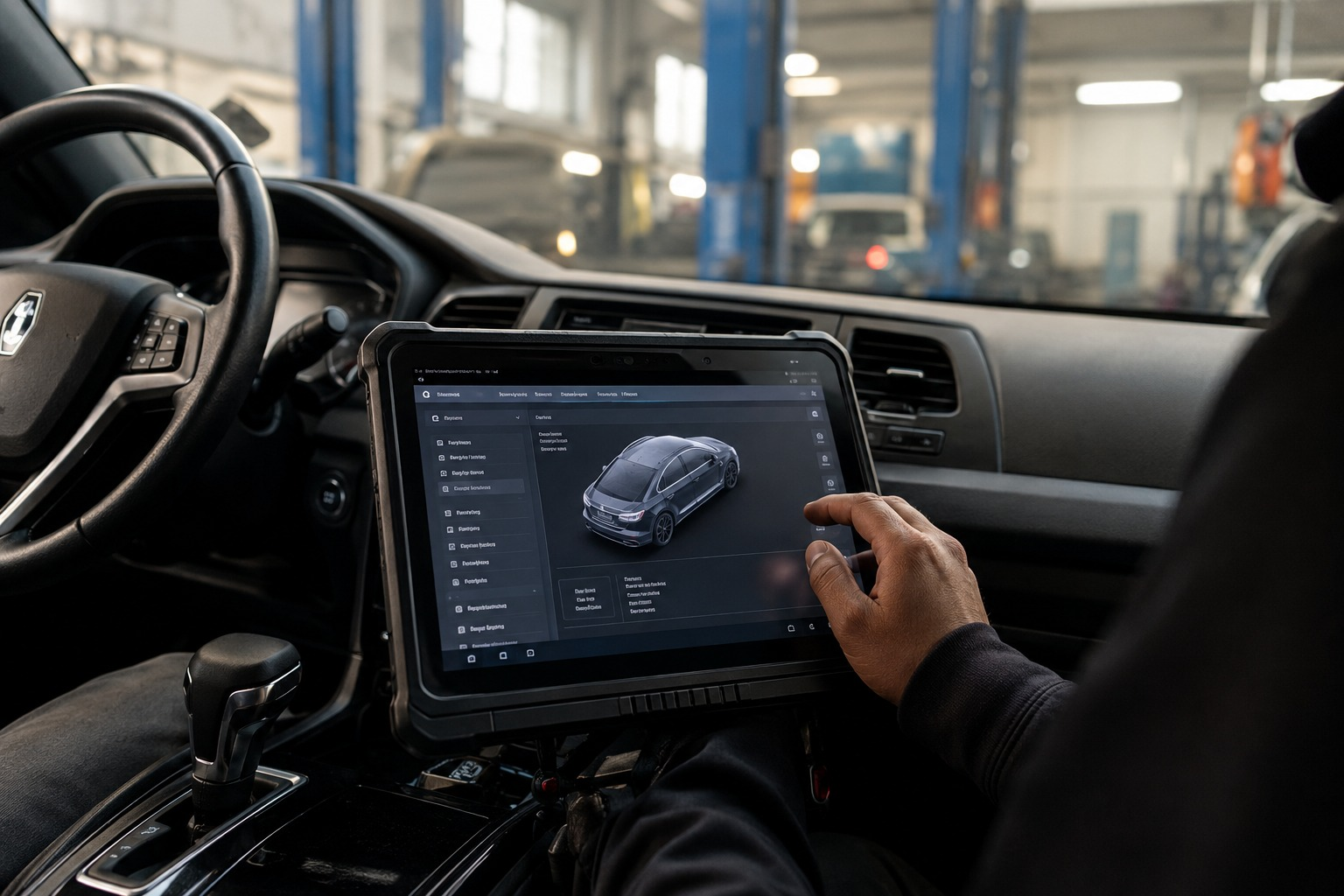


Explore the automotive software solutions that are changing vehicle design, connected services, battery control, diagnostics, manufacturing, maintenance, and driver experience.
A car can leave the factory mechanically complete and still feel unfinished six months later. Drivers now expect navigation updates, remote diagnostics, smarter battery controls, connected services, personalized cabins, and safety features that improve after purchase. That expectation has changed what automakers sell. The vehicle is no longer only a manufactured product. It has become a software platform on wheels.
This shift explains why automotive software solutions now influence vehicle design, manufacturing, ownership, maintenance, and resale value. Software teams no longer work at the end of product development. They shape electrical architecture, battery performance, infotainment, driver assistance, production planning, dealership service, and customer subscriptions from the start.
The market is moving fast. The companies gaining ground will not simply add more code. They will build connected architectures that let vehicle, factory, cloud, supplier, dealer, and driver systems exchange trusted data without slowing product releases.
Why Automotive Software Solutions Now Define Vehicle Value
Mechanical performance still counts, but software increasingly decides how a driver experiences a vehicle after leaving the showroom. A slow interface, unreliable phone connection, poor charging estimates, or failed over-the-air update can damage the ownership experience even when the engine, battery, and chassis perform well.
Modern automotive software solutions create value across three timelines. Before production, they support simulation, digital twins, virtual testing, and supplier coordination. During vehicle use, they manage infotainment, advanced driver assistance systems, telematics, battery health, cybersecurity, and connected services. After the sale, they support remote repairs, feature updates, predictive maintenance, and subscription revenue.
This also changes product planning. Automakers once developed features around fixed model-year cycles. Software-defined vehicle architecture allows teams to release selected functions after production, provided the hardware, safety controls, and update framework support them.
That flexibility brings risk. Code from several suppliers may run across dozens of electronic control units. A weak dependency can affect safety, privacy, availability, or regulatory compliance. Strong automotive industry software solutions, therefore, need disciplined software governance, traceable components, controlled deployment, and rollback plans. Fast releases mean little when a failed update leaves thousands of vehicles waiting for service.
Connected Vehicle Software Solutions Turn Data Into Useful Action
Connected vehicles generate data from sensors, location systems, batteries, cameras, infotainment units, diagnostic modules, and driver interactions. Collecting that data is the easy part. Moving the right data to the right system, with the right permission and latency, takes far more work.
The best automotive software solutions separate urgent vehicle functions from cloud-dependent services. Braking, steering, and other safety-sensitive controls cannot depend on a distant server. Fleet analytics, route planning, remote diagnostics, media services, and selected personalization features can use cloud processing when the architecture handles outages without harming core operation.
Telematics Platforms Improve Fleet And Vehicle Operations
Telematics software combines location, vehicle condition, driver behavior, fuel or battery use, service history, and route information. Fleet operators use it to schedule maintenance, monitor utilization, reduce idle time, and spot repeated operating problems.
A useful platform should do more than display dots on a map. It should connect telematics feeds with maintenance systems, compliance workflows, dispatch tools, and finance records. Hubops followed this approach when it brought separate telematics, maintenance, and administrative tools into one operating structure for Calgary Freight Lines. The fleet compliance and uptime customer story shows how unified data and predictive maintenance supported a 15% improvement in fleet uptime.
That is where many automotive programs struggle. They buy dashboards before fixing data ownership, alert rules, duplicate records, and workflow handoffs. The screen looks modern, but staff still reconcile information manually.
Over-The-Air Updates Extend The Vehicle Lifecycle
Over-the-air software updates let manufacturers fix selected defects, update maps, revise interfaces, adjust energy controls, and release compatible functions without asking every driver to visit a dealership.
Good OTA architecture requires signed packages, encryption, staged deployment, version tracking, compatibility checks, rollback capability, and enough local storage to recover from interrupted installations. Teams also need rules for vehicles with poor connectivity, aging hardware, or modified components.
The security stakes have risen. The US Bureau of Industry and Security’s Connected Vehicles Rule, issued in January 2025, restricts certain connected vehicle software and hardware linked to China or Russia because remote access and sensitive data create national-security exposure. Software restrictions apply to model year 2027 vehicles.
This policy shows why software supply-chain records have become a board-level issue. Automotive leaders need to know who built each component, where developers maintain it, what permissions it holds, and how teams will patch it over a long vehicle life.
EV Software Platforms Improve Battery Performance And Charging
Electric vehicles depend on automotive software solutions at nearly every operating layer. Battery management systems estimate charge, monitor cells, regulate temperature, limit unsafe conditions, and calculate available power. Charging software manages authentication, billing, charger communication, scheduling, and grid interaction. Route software considers charger location, weather, terrain, traffic, battery temperature, and expected consumption.
Drivers notice failures quickly. A vehicle may have excellent battery hardware yet frustrate owners with inaccurate range estimates or failed charging sessions. Those problems often come from poor data exchange between the vehicle, charging network, payment service, and navigation platform.
Global EV registrations reached 20.7 million vehicles in 2025, according to Reuters coverage of Benchmark Mineral Intelligence’s Global EV Sales Review. The same report projected 23.9 million sales for 2026.
That scale makes interoperability urgent. Automotive teams must test charging software across networks, regions, payment systems, connector types, and degraded network conditions. A successful lab session does not prove that a tired driver can start a charge at a rural station during weak cellular coverage.
Automotive Manufacturing Software Connects Engineering And Production
Vehicle software development cannot stay separate from factory operations. A software-defined vehicle may require specific hardware versions, calibration files, certificates, configurations, and regional settings at the production line. One mismatch can create rework or send the wrong configuration into a finished car.
Modern automotive industry software solutions connect product lifecycle management, manufacturing execution, enterprise resource planning, quality systems, supplier portals, and vehicle configuration records. Teams need a digital thread that follows each vehicle from engineering release through assembly, testing, delivery, service, and future updates.
Automotive manufacturers can borrow useful operating patterns from other safety-sensitive transport sectors. Our aviation technology solutions work shows how sensor data, predictive maintenance, integrated operations, and controlled system access support complex assets that cannot tolerate careless deployment.
Digital Twins Reduce Expensive Physical Iterations
Digital twins create a software representation of a vehicle, component, battery, production cell, or factory process. Engineers can use the model to test design changes, investigate failures, compare operating conditions, and assess production choices before spending money on physical changes.
A digital twin only works when its data stays accurate. A beautiful simulation built on outdated component information gives teams a faster route to the wrong answer. Companies need ownership rules, version control, validated sensor feeds, and links back to engineering records.
Predictive Quality Software Finds Patterns Earlier
Machine vision and predictive quality tools can identify weld issues, paint defects, assembly variation, unusual vibration, and component patterns that manual inspection may miss. The strongest systems do not replace quality engineers. They direct attention toward units and processes that deserve closer review.
This demands stable data pipelines. Images, machine readings, supplier batches, workstation settings, and inspection outcomes must line up against the correct vehicle record. Without that link, the model may flag a problem but leave the plant team unable to find its cause.
Advanced Driver Assistance Software Requires Controlled Engineering
ADAS platforms use cameras, radar, ultrasonic sensors, maps, positioning data, and control software to support functions such as lane assistance, adaptive cruise control, parking support, collision warnings, and automatic emergency braking.
These automotive software solutions must handle weather, faded road markings, unusual vehicles, construction zones, glare, sensor obstruction, and driver misuse. Testing, therefore, needs simulation, closed-course work, road testing, scenario libraries, and post-release monitoring.
NHTSA requires identified manufacturers and operators to report certain crashes involving automated driving systems and SAE Level 2 driver-assistance systems under its Standing General Order on Crash Reporting. The rule helps the agency monitor safety issues and investigate possible defects.
Automakers also need precise driver communication. Marketing language must not imply that an assistance feature can perform beyond its approved capability. Interface design, warning timing, driver monitoring, and handover behavior belong in the safety discussion, not just the user-experience review.
CTA: Is Your Vehicle Software Stack Slowing New Feature Releases?
Build connected, secure automotive platforms with Hubops that bring vehicle data, production systems, cloud services, and customer applications into one working architecture.
Automotive Cybersecurity Software Protects More Than The Dashboard
Every connected function creates another route that security teams must assess. Bluetooth, Wi-Fi, cellular modules, diagnostic ports, mobile apps, charging connections, supplier tools, and cloud APIs can all expose vehicle or customer data when teams configure them poorly.
Secure automotive software solutions need identity controls, encryption, certificate management, network segmentation, secure boot, code signing, threat monitoring, component inventories, and incident response. Teams also need a plan for supporting vehicles long after the initial engineering group has moved to another program.
Security work cannot stop at the vehicle. Charging platforms, dealer systems, roadside services, mobile accounts, and customer portals carry data that attackers may target. Automotive companies should test the full service chain rather than treating each product as a separate security boundary.
Electric mobility also creates closer ties between vehicles and energy infrastructure. Hubops approaches these dependencies through utilities' digital transformation, where distributed assets, grid data, predictive maintenance, access control, and operational continuity must work together.
Mobility Platforms Create Revenue Beyond Vehicle Sales
The next wave of automotive software solutions reaches beyond the vehicle itself. Mobility platforms support car sharing, subscription fleets, roadside support, multimodal travel, digital keys, usage-based services, insurance connections, charging plans, and commercial fleet operations.
Revenue does not appear merely because a vehicle has connectivity. Drivers must see enough utility to keep paying. A subscription for heated seats may feel artificial when the hardware already exists in the car. A subscription that includes theft tracking, remote diagnostics, charging discounts, and rapid roadside support may carry a stronger case.
Automakers should test pricing, adoption, cancellation, customer support load, and feature use before treating software subscriptions as dependable income. They also need one customer identity across vehicle, mobile app, finance, dealer, and service records. Duplicate profiles and broken permissions can turn a promising service into months of support tickets.
How Hubops Builds Automotive Industry Software Solutions
At Hubops, we treat automotive software solutions as operating systems for the wider automotive business, not isolated applications. Our work can connect engineering data, plant systems, telematics, maintenance, cloud services, customer portals, analytics, and AI models through one governed architecture.
We start with the operating problem. A manufacturer may need shorter release cycles. A fleet may need fewer breakdowns. An EV provider may need better charging reliability. A mobility business may need one customer and vehicle record across several services. The technology plan follows that need.
We also look beyond deployment. Teams need observability, ownership, security controls, adoption planning, and a release process they can run after handover. The MedSupply inventory and recall customer story comes from another regulated sector, yet its lesson fits automotive work: connected data, automated workflows, traceability, and controlled access must arrive together.
CTA: Ready To Build Software-Led Mobility Without Creating Another Silo
Work with Hubops to design automotive platforms that connect vehicles, factories, fleets, partners, and customer services around usable data and secure workflows
Final Thoughts On Automotive Software Solutions
The automotive sector is not moving from hardware to software. It is learning how to engineer both as one product. That requires more than infotainment screens or a collection of cloud tools. It requires vehicle-safe architecture, traceable code, secure connectivity, dependable data, factory integration, controlled updates, and services that drivers will use.
The strongest automotive software solutions will not chase every technology trend. They will solve specific operating and customer problems, survive poor network conditions, support long product lifecycles, and remain serviceable across suppliers and regions.
For automakers, suppliers, fleet operators, and mobility providers, the next step should start with one question: where does disconnected software already slow delivery, raise risk, or weaken the customer experience? Fix that point first. Then build outward.
Frequently Asked Questions
What software is most commonly used in connected vehicles?
Connected vehicles use embedded operating systems, telematics platforms, infotainment software, diagnostic tools, cloud services, mobile applications, cybersecurity controls, and over-the-air update systems.
How is a software-defined vehicle different from a connected car?
A connected car exchanges data with external systems. A software-defined vehicle uses centralized software architecture to control, update, and expand more vehicle functions throughout its lifecycle.
Can automotive software reduce vehicle recalls?
Software can identify defects earlier, improve component traceability, support remote diagnostics, and fix eligible faults through OTA updates. Hardware defects still require inspection or physical repair.
How long should automotive software receive security updates?
Support should reflect the expected vehicle life, regulatory requirements, component risk, and service commitments. Automakers need updated plans that extend well beyond the initial warranty period.
What should automotive companies assess before choosing a software partner?
They should review automotive domain experience, functional-safety knowledge, cybersecurity methods, integration capability, testing standards, release governance, data architecture, and long-term support capacity.