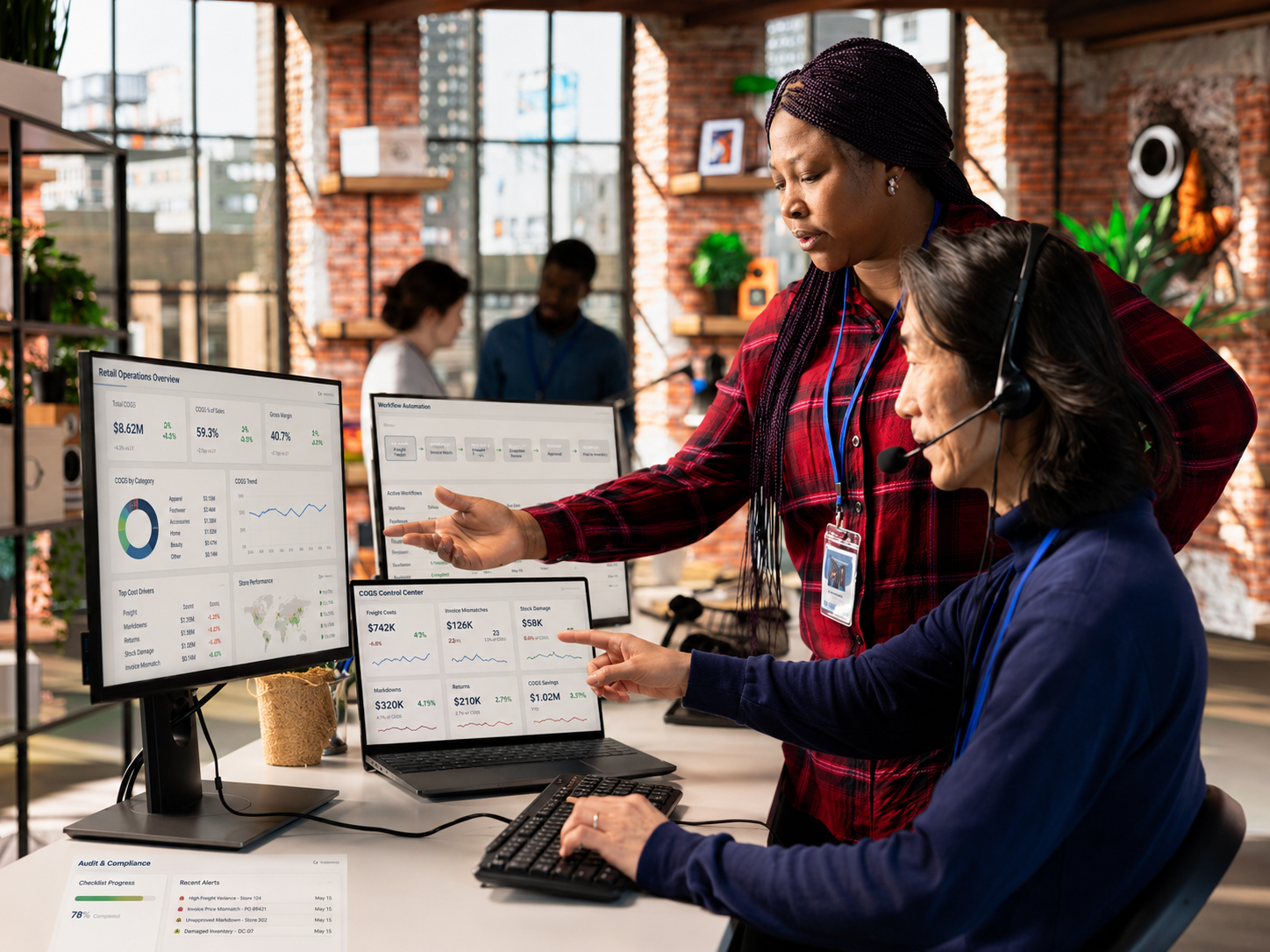


Bring retail costs into one workflow to spot COGS leaks early and protect margins across every channel.
A product can sell all week and still leave the retailer wondering where the margin went.
The supplier price looked acceptable. The campaign worked. Units moved. Then finance closes the month and finds extra freight, invoice mismatches, damaged stock, markdown losses, returns, and several small adjustments that nobody noticed while they were happening.
That is the problem retail COGS transformation is meant to solve.
It is not only a finance project. Buying teams influence cost before an order is placed. Warehouse teams affect it when stock arrives. Store teams affect it through damage, transfers, and markdowns. E-commerce teams add packaging, delivery, and return costs. When those teams work from different numbers, retail profitability starts leaking in places that are hard to spot.
The German Retail Association’s 2026 Retail Survey, reported by Reuters on July 14, 2026, found that 69% of surveyed retailers had lower profits than a year earlier. Purchasing, labour, and energy costs were among the pressures mentioned. Retailers cannot wait for the month-end reports to show where costs moved. They need earlier signals.
Retail COGS transformation gives teams an earlier view. Not by automating everything at once, but by finding the cost leaks that keep coming back and fixing those first.
Retail COGS Transformation Starts With A Clear Cost Trail
Before changing systems, follow one product from the supplier quote to the customer sale. A retailer buys a kitchen appliance for £40. Freight, packaging, damage, markdowns, and returns push the actual cost higher. The original £40 quickly becomes a poor guide.
A proper cost trail should show how the figure changed, who approved each change, and where the final margin ended up. Without that trail, teams argue over reports instead of fixing the process.
Agree On What Counts As COGS
Different retailers classify costs differently. Product purchase cost is obvious. Freight, duties, packaging, fulfilment, and handling may be included depending on the accounting policy.
Problems begin when every team uses its own version.
Merchandising may use the negotiated price. Finance may use standard cost. The ERP may hold an older figure. E-commerce reporting may pull from a separate feed. Nobody planned the confusion. The setup simply grew that way.
Retail COGS transformation needs a governed baseline with effective dates, owners, and approval rules. Planned cost should stay separate from actual landed cost. That keeps the buying view useful without damaging financial accuracy.
At Hubops, we often begin with a cleaner cost map: where the number starts, where it changes, and who approves it. That usually reveals the first savings opportunity.
Procurement Automation Can Protect Retail Profitability Earlier
Many cost problems begin before the stock reaches the warehouse. A supplier sends a revised price by email, but the ERP keeps the old figure. Or a cheaper order requires emergency freight and loses the expected savings.
Procurement automation supports retail COGS transformation by bringing those details into one decision flow. The World Bank’s Commodity Markets Outlook, April 2026, projected overall commodity prices to rise 16% in 2026, while energy prices were projected to rise 24%. Retailers cannot control that outside pressure. They can see which categories are exposed, which suppliers changed terms, and which products no longer meet the approved margin range.
Check Supplier Changes Before Orders Go Out
A strong procurement workflow should compare more than the unit price. It should also review freight, payment terms, minimum order quantity, lead time, defect history, rebates, and supplier fill rate.
Two checks are especially useful:
- Match purchase orders, goods receipts, and invoices before payment.
- Flag cost changes that push a product below its approved gross-margin threshold.
The buyer should see the old cost, the new cost, the affected order, the margin impact, and the approval owner. “Price variance detected” tells them very little.
Retailers planning AI-supported buying or supplier review can use our guide on how to add AI to business applications without breaking workflows. It covers approval steps, human review, and the risk of adding automation to a process that has not been cleaned up first.
Inventory Automation Changes More Than Stock Levels
Inventory is where product cost turns into cash, markdowns, shrinkage, transfers, expiry, and lost sales.
A product may have a healthy margin at the supplier stage, then lose much of it because it was ordered for the wrong location or stayed unsold too long.
Use Forecasts As Working Advice
Forecasting tools can process sales history, seasonality, campaigns, weather, lead times, stock-outs, and channel demand. They still need review from people who know the category.
Local knowledge still counts. A planner may know about an event, a competitor closure, or a supplier that ships late before holidays. The better process is forecast, review, approve, and measure.
Keep the override history. Then check whether the human change improved sell-through or created excess stock. Retail COGS transformation should make decisions easier to review later, not bury them inside a model.
Find Shrinkage Before Month-End
Shrinkage is often reported as one large number. Store and warehouse teams cannot do much with that.
Automation can compare sales, cycle counts, receiving scans, returns, damage records, transfers, and expiry data. It can show where the loss keeps appearing.
Useful signals include repeated shortages on one supplier route, unusual damage in one store, or returns that do not match warehouse scans. Retail profitability improves when the system points to a pattern rather than sending another broad warning.
Warehouse Automation Should Begin With Cost Per Unit
Retailers often hear “warehouse automation” and think of robotics or a fully redesigned building. Sometimes that is right. Often it is not the first step.
Retail COGS transformation may begin with receiving scans, better slotting, carton selection, pick-path changes, carrier rules, or more accurate labour planning.
The Financial Times reported in March 2025 that Amazon estimated its heavily automated Shreveport facility had reduced order fulfilment costs by 25%. Morgan Stanley analysts cited in the report estimated that similar investments across Amazon’s network could produce about $10 billion in annual savings by 2030.
Most retailers operate at a very different scale, so copying Amazon would be pointless. The useful lesson is the measurement approach. Automation needs a cost baseline. Otherwise, the business may install expensive technology and still be unable to show what has improved.
Separate Store Replenishment From E-commerce Fulfilment
Store replenishment and e-commerce orders behave differently.
A store shipment may use full cases and scheduled transport. E-commerce often involves single-item picks, packaging, failed delivery, and returns. One average hides the difference.
Retail COGS transformation should show receiving, storage, picking, packaging, delivery, return, and transfer costs by channel. Start with the figures that change decisions.
A warehouse manager may learn that a packaging rule adds 40p to thousands of weekly orders. That is more useful than a dashboard full of percentages with no action attached.
CTA: Are Fulfilment Costs Rising Faster Than Order Value?
Connect warehouse, supplier, inventory, and order data with Hubops so your retail COGS transformation program can target avoidable costs without slowing daily fulfilment.
Connected Retail Data Keeps Automation Useful
Retail automation often fails for a boring reason. The systems do not agree.
The POS, ERP, supplier invoice, and e-commerce platform may all identify the same product differently. Finance then spends days explaining why reports do not match.
Retail COGS transformation depends on connected transaction data. That does not always require replacing the core stack. Shared records, timely updates, and fewer fragile connections may be enough.
Our resource on how to build an api connectivity strategy that supports growth automation and better data flow covers this problem in more detail. It is useful for retailers connecting ERP, POS, ecommerce, procurement, warehouse, and analytics systems.
Send Fewer Alerts, But Make Them Better
Store, buying, and warehouse teams already deal with enough notifications. Another alert feed will not improve retail profitability.
A better workflow groups related events and shows the likely financial impact. A late shipment may not need action. If the delayed product belongs to a live campaign, store cover is low, and emergency freight would cost £8,000, it deserves attention.
Hubops supports these programs through our technology services, covering application work, data movement, cloud operations, workflow design, and automation. We focus on the operating outcome as well as technical delivery. A system can go live successfully and still fail to improve cost.
A Retail COGS Transformation Roadmap Teams Can Use
Large programs often begin with too much scope. Procurement, warehouse systems, inventory, forecasting, and returns all enter phase one. Delivery slows down.
A better retail COGS transformation roadmap begins with one expensive leak and one group that owns it.
Reuters reported in January 2025 that UK retailers expected about £7 billion in additional annual costs from higher employer contributions, wage increases, packaging levies, and business rates. Some of those costs fall outside COGS, but they increase the pressure to reduce waste inside product and fulfilment operations.
Choose A Pilot With Visible Leakage
Good first projects include supplier invoice mismatch, landed-cost updates, markdown timing, parcel spend, or return handling. Measure the current exceptions, time spent, financial exposure, and data quality. Then automate one part of the flow.
Ask two questions:
- Did the change prevent a named cost or reduce a repeated error?
- Can finance, operations, and merchandising trace the result to the same transaction?
If not, scaling will only spread the confusion.
Protect Margin Without Creating Another Cost
Cost reduction can backfire.
Cheaper freight may create stock-outs. Lower inventory may increase lost sales. Faster picking may increase errors and returns.
Retail COGS transformation should track landed-cost variance, invoice accuracy, shrinkage, markdown recovery, fulfilment cost per order, return-processing cost, and product availability.
Our industry technology solutions approach allows us to shape the work around the retailer’s product life, channel structure, supplier network, fulfilment model, and store operations. Grocery, fashion, electronics, and homeware do not carry the same cost pressures.
How Hubops Approaches Retail COGS Transformation
At Hubops, we begin by tracing how cost moves through the business.
We look across supplier data, purchase orders, inventory, receiving, fulfilment, returns, markdowns, and finance. The answer may be a governed data flow, a better approval path, or a targeted integration.
Buyers should see margin exposure before releasing an order. Warehouse teams should receive fewer vague alerts. Finance should close with fewer unexplained adjustments. Leadership should see the cost-effectiveness while there is still time to act.
CTA: Where Is COGS Leakage Hiding In Your Retail Operation?
Work with Hubops to map procurement, inventory, warehouse, supplier, and finance workflows, then build a retail COGS transformation plan around the leaks that keep returning.
Final Thoughts On Retail COGS Transformation
Retailers rarely lose margin in one dramatic event. It usually disappears through small decisions and delays.
An old supplier price remains active. A damaged shipment is recorded late. A product reaches the wrong location. A markdown starts two weeks late. A packaging rule adds cost to every order. A return comes back, but does not update the inventory correctly.
Retail COGS transformation brings those problems closer to the teams that can fix them. Start with a reliable cost trail. Choose one repeated leak. Connect the records involved. Keep people in the approval loop where judgement is still needed. Then measure what changed.
That approach may look less impressive in a presentation. It is far more useful in an operating business. For retail profitability, earlier action usually beats a polished report after the loss has already happened.
FAQs
What is retail COGS transformation?
Retail COGS transformation improves how product and fulfilment costs are recorded, checked, approved, and acted on across procurement, inventory, warehouse, stores, ecommerce, and finance.
Which retail process should be automated first?
Start with a process that has visible leakage and dependable data. Supplier invoice matching, landed-cost updates, markdown timing, stock adjustments, and parcel-cost checks are common choices.
Can inventory automation reduce COGS?
Yes, when it reduces excess stock, spoilage, emergency replenishment, shrinkage, and late markdowns. Poor rules can create stock-outs, so human review should remain part of the process.
How does automation support retail profitability?
It helps teams catch price changes, invoice errors, stock loss, fulfilment waste, and margin pressure before those costs spread across more orders or locations.
Can Hubops work with existing retail systems?
Yes. Hubops can improve workflows and data connections around the current environment. A full replacement is not always required.