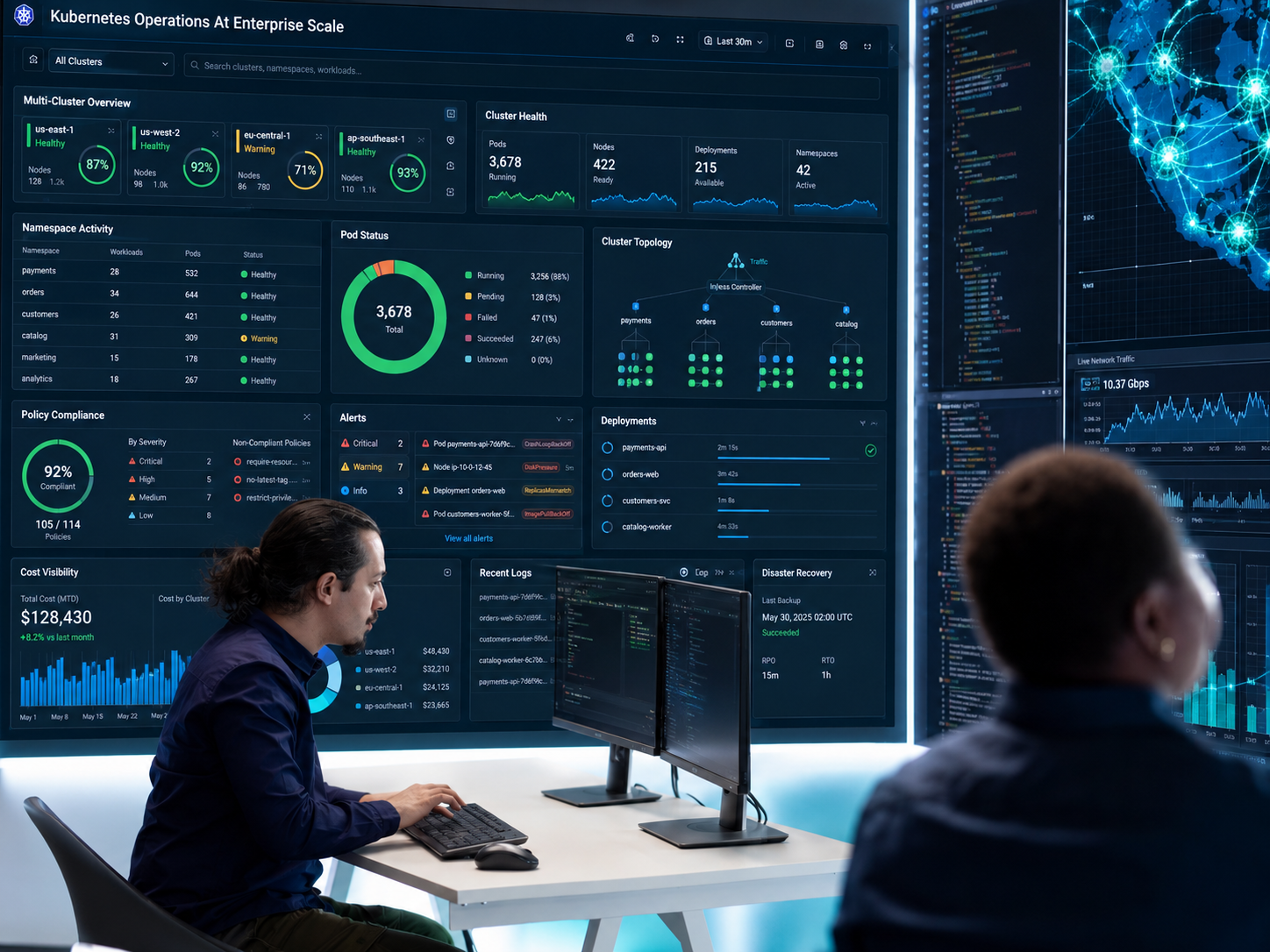


Run Kubernetes at scale without turning every cluster, policy, and alert into a separate operational fire.
A cluster can look healthy at 9:00 a.m. and still block three product teams by lunch. A certificate expires. A policy behaves differently in another region. Nobody sees the pattern because each team has its own dashboards, alerts, and escalation route.
That is the hard part of Kubernetes operations. Installation is no longer the main challenge. Running clusters consistently across business units, clouds, data centres, countries, and regulated workloads is. Developers need speed, while security, finance, and compliance teams need control, evidence, and dependable recovery.
Good Kubernetes operations bring those needs into one operating model. They define provisioning, releases, policy changes, logging, cost ownership, and response when a shared service fails. The goal is dependable automation with clear ownership, not automation for its own sake.
Why Kubernetes Operations Become Hard At Enterprise Scale
A small platform team can manage a few clusters through direct conversations. That approach breaks as the estate grows. Ten clusters become fifty, one cloud becomes three, and acquired companies bring different tooling, policies, and release windows.
Kubernetes operations then become an organisational problem as well as a technical one. Platform, security, application, finance, and compliance teams each own part of the service. Incidents cross those boundaries while customers wait.
Eurostat’s report, Cloud Computing: Statistics On The Use By Enterprises, found that 52.74% of EU enterprises used paid cloud services in 2025, up 7.42 percentage points from 2023. Adoption among large enterprises reached 84.67%, showing why cluster estates increasingly span several environments.
Cluster Growth Creates Uneven Operating Standards
The first production cluster usually receives close attention. Later clusters appear for regions, products, acquisitions, data boundaries, or temporary programmes. Some run current components. Others depend on old controllers, inconsistent policies, or scripts with no owner.
That unevenness raises support effort. Teams cannot assume the same deployment, observability, identity, or rollback process everywhere.
Cloud-Native Infrastructure Needs Clear Ownership
Cloud-native infrastructure divides responsibility across layers. A provider may operate the control plane, while the enterprise still owns nodes, workload identity, network rules, secrets, backups, and application reliability. Managed does not mean fully operated.
Write ownership around services, not job titles. For each shared component, name who approves changes, responds to alerts, handles upgrades, and communicates during failure. DNS, certificates, admission policies, service mesh configuration, and registries all need accountable owners.
Reliable Kubernetes operations need an escalation map naming primary owners, backup owners, vendors, and communication paths for all shared failures.
Building A Standard Kubernetes Operations Model
Standardisation should reduce repeated decisions without forcing every application into one template. Decide which controls must remain identical and where teams can choose.
A baseline should cover provisioning, identity, network policy, secrets, image verification, logging, metrics, backups, upgrades, and retirement. Application teams can then select approved deployment patterns based on workload needs rather than negotiating every control again.
The platform also needs a service catalogue showing available capabilities, support levels, and the route for requesting changes. Hidden features encourage private workarounds that later become production dependencies.
Use Platform Engineering To Remove Ticket Queues
Platform engineering works when the approved route is faster than bypassing it. Self-service can create namespaces, apply policies, connect repositories, register ownership, and install observability settings. Developers get usable environments while the platform team keeps consistency.
Start narrowly. Automate requests that arrive every week, such as namespace creation, test environments, standard CI/CD pipelines, certificate requests, database access, and approved secret references.
Our system integration services connect deployment tooling, identity, service management, monitoring, and business systems without rebuilding every working component. This helps remove fragile handoffs around approvals, access changes, incident routing, and release evidence.
Set Two Non-Negotiable Platform Rules
- Every production workload must have a named owner, tested rollback route, resource limits, and an agreed recovery target.
- Every cluster change must pass through version-controlled configuration, peer review, automated checks, and a traceable deployment record.
Simple rules remove confusion during high-pressure incidents.
Consistent Kubernetes operations make audits easier because teams can compare actual changes against one approved release process.
Kubernetes Operations For Multi-Cluster Environments
Multi-cluster Kubernetes may support resilience, regional performance, data location, or acquisitions. It can also multiply inconsistency. Central control helps only when local teams can still operate during network trouble or management-plane failure.
Group clusters by operating need rather than provider. Production workloads may need tighter change controls, regulated workloads separate logging and keys, and GPU clusters different scheduling and cost policies. Those differences should shape policy and support.
The Hubops whitepaper on mixing private and public clouds explains why workload placement should follow performance, compliance, resilience, and cost. Kubernetes offers a common orchestration layer, but controls must still reflect location and failure conditions.
Design For Provider And Regional Failure
The Associated Press report Massive Amazon Cloud Outage Has Been Resolved After Disrupting Internet Use Worldwide covered the October 2025 AWS disruption. DownDetector logged over 11 million problem reports across more than 2,500 companies, while AWS said 64 internal services were affected.
Not every enterprise needs active-active deployment across providers. It does need visibility into dependency concentration. A secondary cluster offers little protection when it shares identity, DNS, registry, secrets, or deployment control with the primary environment.
Test failure at dependency level. Disable the registry, break an external DNS route, remove a region from the pipeline, and restore an application into a clean cluster. Such exercises expose false redundancy early.
Keep Fleet Management Boring
Fleet management should quickly show unsupported clusters, policy drift, capacity pressure, missing owners, vulnerable components, and certificates nearing expiry.
Avoid a command centre packed with unused charts. Start with exception reports and action queues so teams see the few clusters or workloads needing attention.
Well-run Kubernetes operations turn fleet data into scheduled work, so upgrades and policy repairs happen before emergencies.
CTA: Are Expanding Clusters Making Every Release Harder To Control?
Build Kubernetes operations with Hubops that standardise provisioning, policy, observability, and recovery while keeping active product teams moving.
Security And Governance In Kubernetes Operations
Kubernetes security cannot wait for a final production review. Controls belong in cluster templates, deployment pipelines, workload identity, admission rules, and runtime monitoring.
The UK government’s Cyber Security Breaches Survey 2025/2026 found that 43% of businesses identified a breach or attack in the previous year, rising to 69% among large businesses. Only 15% reviewed risks from immediate suppliers.
Reduce Access Before Adding More Detection
Start with identity. Administrators should use short-lived, role-based access with multifactor authentication. Workloads need dedicated identities, production access must be logged, and ownerless service accounts should be removed.
Then tighten software supply-chain controls. Approved base images, signing, vulnerability scanning, dependency records, and admission policies reduce unverified software. Every exception needs an owner and expiry date.
Our api and connectivity services support governed endpoints, secure data exchange, event-driven workflows, and monitored connections between clusters, SaaS platforms, internal applications, and partner environments.
Apply Policy Without Blocking Every Team
A policy developers regularly bypass is not working. Begin in visibility mode where possible, show which workloads would fail a future rule, and provide a repair route before enforcement.
Two controls deserve early attention:
- Block privileged containers, unapproved registries, risky host mounts, and workloads running without defined security contexts.
- Require ownership labels, resource requests, health checks, approved secret handling, and environment-specific network policies.
Separate policy authorship from emergency exception approval. One person should not write, bypass, and close the same record.
Secure Kubernetes operations require periodic access reviews for contractors, automation accounts, break-glass roles, and inherited permissions.
Observability And Incident Response For Kubernetes Operations
Enterprise observability should connect customer symptoms to application behaviour, cluster health, network paths, and recent changes before the incident spreads.
Use a consistent telemetry contract. Services should publish request, error, duration, and saturation signals. Logs need shared fields for service, environment, cluster, region, version, and owner.
Connect Alerts To Action
If an alert has no owner, runbook, severity, or expected action, it should not page someone. Route platform and application alerts separately, but share an incident channel when failure crosses both.
Change intelligence helps engineers find causes faster. When something changes, show it next to the service data. That includes deployments, policy updates, node upgrades, autoscaler activity, and configuration changes.
The AI-driven network modernisation guide also explains how teams can track changes, roll them back, and keep network policies, service discovery, ingress, and cluster connections working.
Practise Recovery With Application Teams
A backup is useful only if the restore actually works. Test cluster rebuilds on their own. Application recovery can still reveal missing secrets, queues, database permissions, or storage dependencies.
Measure recovery from first alert to customer restoration, then review where time was lost. Incident reviews should produce a short list of engineering changes with owners and dates, not blame.
Resilient Kubernetes operations improve when recovery exercises include product owners, support teams, and vendors, not infrastructure engineers alone.
Cost And Capacity Control For Cloud-Native Infrastructure
Kubernetes can improve infrastructure use but also hide waste. Teams over-request CPU, leave test environments running, duplicate agents, or scale against noisy metrics. The bill rises without one obvious cause.
The International Energy Agency’s Energy and AI report projects global data-centre electricity consumption at around 945 TWh by 2030, roughly twice the 2024 level, with annual growth near 15% through 2030. Infrastructure efficiency now belongs in operating reviews.
Make Cost Visible At Workload Level
Tag costs by product, team, environment, cluster, and customer where appropriate. Show requests, actual use, idle capacity, storage, data transfer, tooling, and shared platform allocation.
Kubernetes cost optimization should start with requests and limits, autoscaling, abandoned environments, oversized nodes, and costly transfer paths. Reserved or spot capacity may help suitable workloads, but neither repairs poor workload design.
Plan Capacity Around Business Events
Retail launches, payroll cycles, ticket releases, regulatory deadlines, and model training create different demand shapes. Test scaling thresholds and dependency limits using previous events, including databases, queues, and external APIs.
Include capacity reviews before major events. Check quota, node pools, registry throughput, autoscaler limits, storage performance, API limits, and support coverage.
Measuring Kubernetes Operations Without Dashboard Theatre
Measure what teams and customers experience: deployment lead time, failed releases, recovery time, upgrade age, exceptions, headroom, alert noise, support requests, and cost per workload.
Do not turn every metric into a target. Use measures to locate friction, test a change, and confirm that the result lasted without damaging another outcome.
A quarterly review should ask where operations interrupted delivery, which repeated task should be automated next, and which component now carries unacceptable risk.
CTA: Need Kubernetes Operations That Stay Reliable As The Estate Grows?
Work with Hubops to improve cluster standards, security controls, observability, cost visibility, and recovery without forcing a disruptive platform reset.
Final Thoughts
Enterprise Kubernetes is not improved by adding tools and scripts. Daily operation has to become predictable.
Strong Kubernetes operations give developers a fast approved route, security teams enforceable controls, finance teams usable cost data, and incident responders clear ownership. Cloud-native infrastructure becomes easier to change because its basics are consistent.
At Hubops, we connect identity, APIs, deployment workflows, observability, governance, and recovery around the cluster. We focus on staged changes teams can use during active delivery.
Start with one painful workflow. Fix ownership, standardise the route, automate repeated steps, and measure the result. Then move on. This approach is less dramatic than a sweeping platform announcement and more likely to survive production.
FAQs
What do Kubernetes operations cover?
They include setting up clusters, handling releases, watching performance, fixing incidents, managing costs, upgrades, recovery, and closing environments.
Why do companies standardise Kubernetes?
Because scattered setups waste time. Shared rules reduce drift, fixes, security gaps, and release confusion.
How should Kubernetes clusters be managed?
Group them by workload, keep a baseline, note exceptions, and test what happens when a region or dependency fails.
What does platform engineering do?
It gives developers self-service options without dropping security, governance, monitoring, or release controls.
How does Hubops help?
We review the estate, connect tools, improve visibility, tighten controls, and roll changes out step by step.