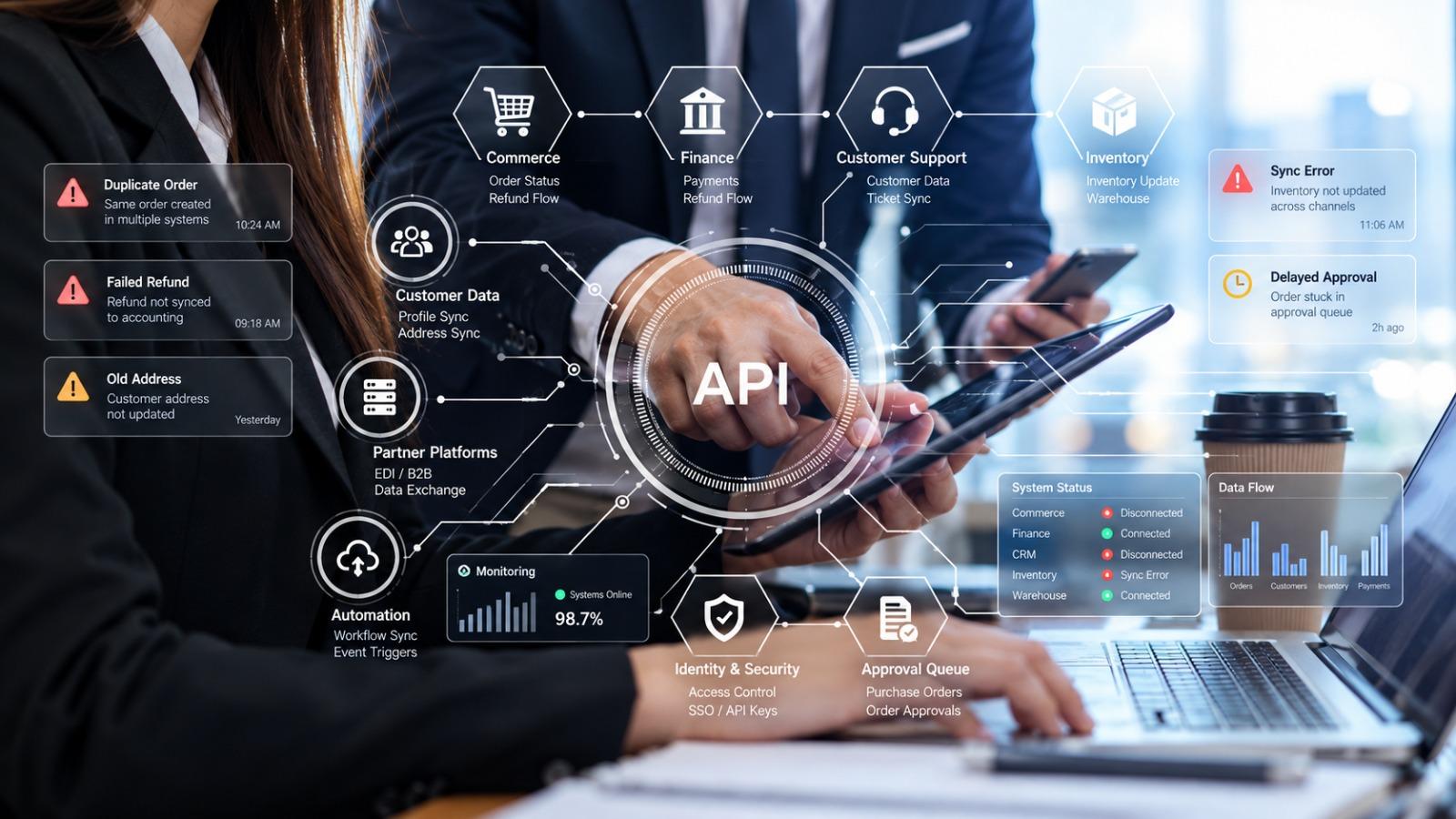


Disconnected systems create data gaps, manual work, and security risks. Learn how API integration services can connect applications, improve data quality, and support reliable business workflows.
TL;DR — Key Takeaways
- Disconnected applications can create duplicate records, delayed updates, and manual reconciliation.
- API integration should begin with the business process and clearly defined data ownership.
- Shared data definitions and API contracts help prevent inconsistent information.
- Authentication, permissions, logging, and monitoring should be designed into every integration.
- A phased integration roadmap can reduce operational risk and make automation easier to manage.
- AI integrations require additional controls around data access, permissions, and human approval.
What happens when a customer updates an address in one system, but the warehouse still sends an order to the old location? The business may blame a staff member, yet the deeper problem often lies between applications that cannot exchange dependable information.
API integration services connect those applications through defined interfaces, shared rules, and monitored data flows. They can link commerce, finance, customer support, inventory, identity, analytics, and partner platforms without asking employees to copy the same record from one screen to another.
At Hubops, we start with the transaction that breaks most often. A failed refund, duplicate order, or delayed approval exposes decisions that never worked together. Fixing the chain requires ownership, data rules, security controls, and a usable release plan.
When systems stay apart, staff reconcile records by hand, customers repeat information, analysts question reports, and managers delay automation because they cannot trust the source data. API integration services connect that work around a measurable outcome.
What API Integration Services Risk When Systems Stay Apart?
Disconnected applications rarely fail dramatically. Each tool continues to function while the complete process becomes unreliable. A CRM stores a new contact, billing keeps the old account number, and support opens a ticket without seeing either update.
That gap grows expensive as the business adds channels, identifiers, schedules, and update times. A retailer may call a customer “active” in loyalty, “closed” in finance, and “unverified” in marketing. Employees decide which label to trust.
Data integration across systems should begin by listing records that drive a process, such as customer, product, order, supplier, payment, employee, or location data. Identify the source that owns each record, its consumers, and the events that change it.
Map The Handoff Before Choosing A Tool
Take a service request. The customer submits a form, identity checks the account, a workflow creates a task, and finance approves a charge. If the workflow only sends an email, the process has no dependable status record. A missed message leaves departments with different versions of progress.
Document the handoff in plain language before selecting middleware or rewriting an application. Ask:
- Which event starts the process?
- Which system owns each decision?
- What information must arrive before the next step can begin?
- What should happen when a message arrives twice, arrives late, or fails?
These questions convert a vague integration request into a design that engineers, operations staff, and auditors can review together.
Our digital innovation services help teams connect product journeys, automation, and system coordination around measurable goals. API integration services work best when the desired business result remains visible throughout design and delivery.
Why Data Quality Decides Integration Results
An API can transfer incorrect information at impressive speed. If one application records a product as “blue” and another uses the code “BLU-01,” a connection that only moves fields will spread the inconsistency. Users still receive incomplete results, but the error now travels faster.
Data integration across systems needs a shared vocabulary. Define names, formats, units, time zones, status values, and acceptable blanks. Decide whether the receiving application may reject a record, hold it for review, or accept it with a warning.
Create Rules For The Records That Keep Moving
Customer identity deserves care. A person may register with a personal email, use a work address later, and appear twice after migration. Without a matching rule, teams can expose a private order or leave support with an incomplete history.
Product and financial data bring similar risks. A price may include tax in one system and exclude it in another. A weight may use kilograms in a warehouse and pounds in shipping. A return may reduce inventory immediately in one application but only after inspection in another.
Write the rule where the integration team can find it. Include an example, an owner, and a test case. When policy changes, update the rule and the affected interface together.
The 2026 Seagate data infrastructure survey, reported by TechRadar Pro, found that 43% of businesses lacked proper data storage infrastructure, while 53% identified data quality and readiness as a major AI deployment difficulty. The survey reflects respondents’ reported conditions, not a universal measure of every company’s data estate.
API integration services need agreed definitions before technical mapping begins.
Security Risks Hidden Inside API Connections
Every connection creates a path into a business process. It may expose customer details, pricing, payment status, employee records, or internal decisions. A gateway can control traffic, but it cannot decide whether an application should receive a field in the first place.
The 2026 Apps, APIs, and DDoS State of the Internet report from Akamai found that 87% of surveyed organisations reported an API-related security incident in 2025. The research was published in an Akamai newsroom release and reflects its survey population.
API integration services should therefore include security design from the first workshop. Use authentication that matches the system’s risk, restrict permissions by task, encrypt sensitive traffic, and record who accessed important data. Avoid giving a delivery application access to every customer attribute merely because the connection is convenient.
Treat Tokens, Logs, And Errors As Production Data
Credentials need an owner, expiry process, and safe storage. Plan rotation before launch. Logs should trace failures without exposing payment details or private records. Mask sensitive fields and write error messages that point to a fix.
API Integration Services And Fragile Point-To-Point Links
A quick connection between two applications can appear sensible when a project has one workflow. The model becomes difficult to manage after every department adds another direct link. A customer update may travel through five routes, each with a different retry rule and owner.
Teams fear changing a field because they cannot list every dependent process. Engineers spend time testing old connections instead of improving customer journeys.
API integration services can reduce that risk through a managed integration layer, event contracts, reusable authentication, and clear ownership. The architecture should still remain proportionate. A small internal process may need one secure interface and a simple monitor, not a large platform with features nobody operates.
Keep Contracts Visible To The Teams Using Them
An API contract should state fields, errors, authentication, limits, and change policy, with examples for normal and failed requests. If a field changes meaning, create a version or give downstream teams time to migrate. Never make “pending review” silently mean “approved.”
Postman’s 2025 State of the API Report, based on more than 5,700 global developers, architects, and executives, linked API strategy with AI strategy. The finding shows why interface decisions now influence automated work as well as ordinary application connections.
CTA: Are Fragmented APIs Slowing Your Business Processes?
Hubops can help review the connections behind delayed approvals, duplicate entries, and unreliable reporting. Start with one process, establish the data owner, and build an API plan that your teams can operate after release.
How API Integration Services Change Daily Work
Successful API integration services remove repeated handling without removing human judgement. A support agent should see the order, payment status, delivery event, and approved options in one work view instead of typing the same number into three systems.
Decide which actions the system can complete, which require approval, and which need an exception queue. If a request already has an open case, link the new message or ask for a decision. Creating a second case makes reporting unreliable and can prompt two employees to contact one customer.
Data integration across systems should preserve source, timestamp, initiating user, and correction reason. Those details let supervisors review exceptions without asking the customer to repeat the story.
API Integration Services And AI Data Controls
Many organisations now connect AI tools to customer records, knowledge bases, and internal applications. The interface may work in a test environment, but production access requires a tighter plan. An AI assistant should not retrieve records simply because an endpoint returns them.
The 2026 Salesforce Connectivity Benchmark Report, based on 1,050 enterprise IT leaders interviewed globally, found that 49% cited cross-application data governance as a top integration challenge. The statistic comes from Salesforce’s report announcement and reflects respondent opinion.
API integration services should make access rules readable to both engineers and business owners. Define which fields an AI tool may retrieve, which actions it may request, and when a person must approve the action. Keep a record of the source data and the instruction that produced a recommendation.
Add Guardrails Before Adding More Automation
Start with retrieval before allowing changes. An assistant can locate an invoice, explain its status, and suggest the next step while finance retains approval. Monitor errors such as wrong accounts, missed policy conditions, or stale records. A larger model will not resolve a missing owner or weak data contract.
Our guidance on cloud operations automation and a practical cloud roadmap covers monitoring, ownership, and controlled automation. The same approach applies when APIs carry requests to AI services.
A Practical API Integration Services Roadmap
Release integration in stages, following risk and customer effect rather than a vendor feature list.
Start With One High-Friction Process
Choose order confirmation, claims intake, supplier onboarding, invoice approval, or employee access. Record wait times, errors, manual corrections, and the person who owns the outcome.
Establish The Contract And Controls
List fields, identifiers, events, failure responses, authentication, permissions, logging, and alerts. Test expired credentials, duplicate messages, unavailable services, and malformed records before production.
Pilot With Exception Handlers
Run a limited transaction group and ask staff to complete normal work and failure paths. Note where they need a second system, manual note, or supervisor decision.
Measure The Business Result
Compare completion time, duplicate records, rejected requests, support contacts, reconciliation work, and complaints with the baseline. Hubops consulting services can connect the roadmap to technology choices, operating duties, and investment decisions.
Prevent API Integration Services Debt After Launch
An API project continues after production. Products add fields, vendors change authentication, and policies shift. Keep an inventory of interfaces, owners, consumers, data classifications, and renewal dates. Remove unused access and track failures by business journey. When a contract changes, give downstream teams time to test and publish the retirement date for old behaviour.
CTA: Need A Clearer Path From Disconnected Systems To Reliable Workflows?
Review your highest-cost handoff with Hubops and define the data, security, and ownership rules that support a controlled integration release.
Final Thoughts
API integration services help businesses connect work that customers and employees already experience as one journey. Their value appears when a payment, order, case, or approval moves through systems with context.
The strongest programmes begin with a broken process, a named data owner, a tested contract, and a recovery path. They treat security and monitoring as part of delivery. They give employees a clear route when the normal path fails.
Hubops approaches API integration services as an operating decision supported by technology. Visible interfaces, data rules, and responsibilities let businesses add automation without losing control.
Frequently Asked Questions
What are API integration services?
API integration services connect applications so they can exchange approved data and trigger defined actions. They may include interface design, authentication, mapping, orchestration, testing, monitoring, documentation, and support. Scope should follow the process being improved.
How Do API Integration Services Improve Daily Operations?How Do API Integration Services Improve Daily Operations?
Integration can remove repeated entry, synchronise status changes, and route tasks to the right team. Results depend on shared definitions, exception handling, and ownership after launch.
Is API integration secure?
An API connection can be secure when teams restrict access, protect credentials, validate requests, encrypt traffic, monitor activity, and test failures. A gateway alone does not prevent an authorised application from receiving unnecessary data.
What is data integration across systems?
Data integration across systems makes information available between applications while preserving meaning, ownership, and history. It can use APIs, events, files, platforms, or a combination. Define the source of truth before moving records.
How long does an API integration project take?
Timelines depend on system count, data quality, security, workflow complexity, and testing. Larger programmes require agreement on ownership, exceptions, migration, and support.