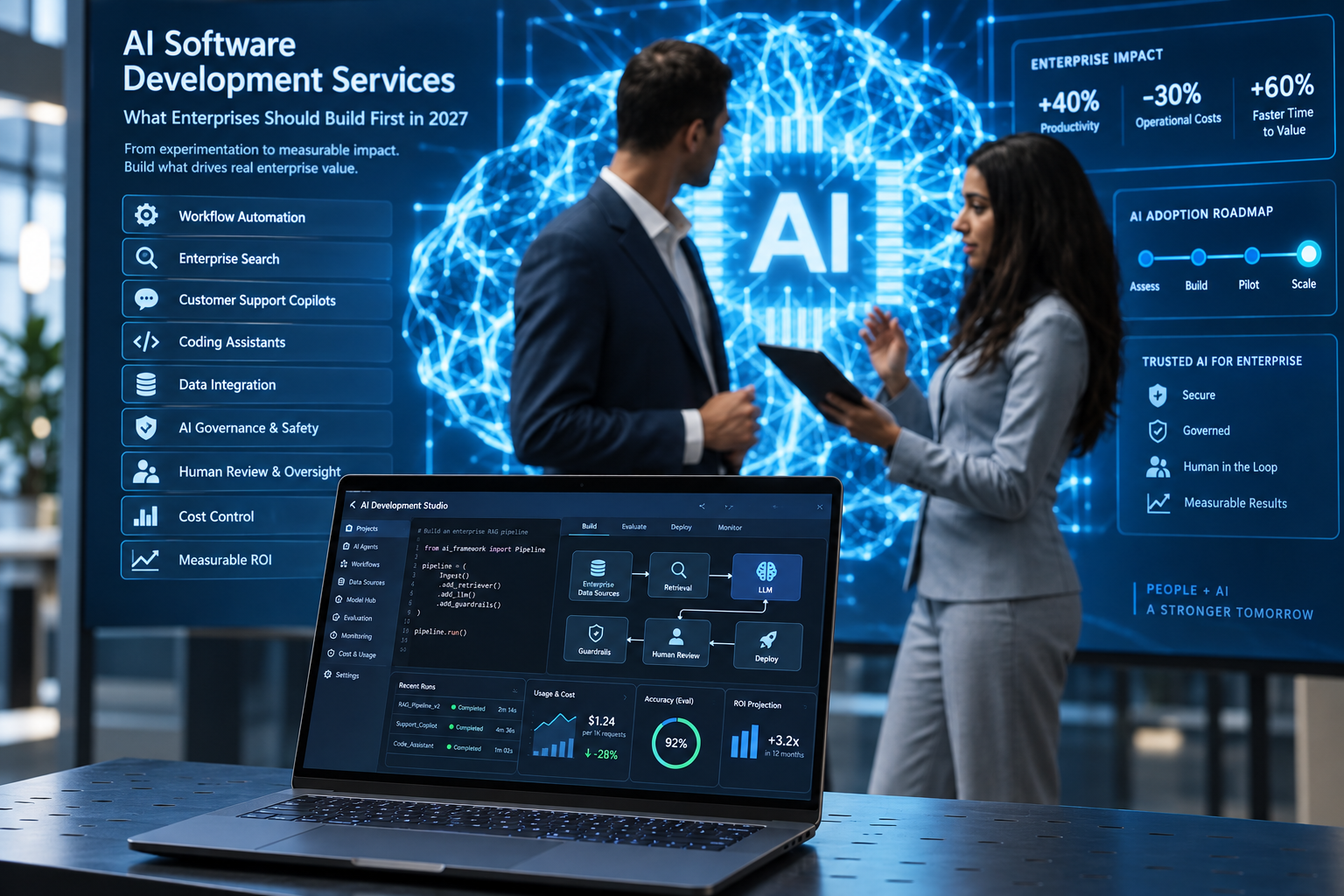


Prioritize AI software that fixes one costly workflow first, then expand with stronger controls and scale.
Buying access to a capable AI model is easy now. Deciding what deserves to be built around it is harder. Enterprise teams are looking at assistants, coding agents, search tools, workflow automation, customer-facing features, and autonomous agents at the same time. Too many possible starts can quickly produce a weak build order.
AI software development services in 2027 should not begin with a model shortlist. They should begin with the work people already do, the systems that hold the data, the decisions that run slowly, and the places where human review cannot disappear. For Hubops, the first question is practical: what job should AI take on, and what has to happen around it for the result to stay useful in production?
Why AI Software Development Services Need A Different Build Order In 2027
Enterprise AI has moved past the stage where a polished proof of concept earns much attention. The pressure now is on production use. Can the application work with company data, respect permissions, produce a useful recommendation, and hand the task back to an employee when confidence drops?
The EY-CII joint survey on enterprise AI adoption, covered by The Indian Express in November 2025, found that more than 47% of Indian companies had moved generative AI pilots into live use cases, while another 23% were still experimenting. Companies do not only need more prototypes. They need production software that can move useful experiments into daily work without creating another isolated tool.
That is why “what should we build?” is a better starting question than “which model should we use?” Models will change. Business processes, dependencies, and access rules do not change as easily.
What Should Enterprises Build First With AI Software Development Services?
A useful build sequence starts with work that is frequent enough to justify engineering, structured enough to test, and valuable enough to measure. AI software development services should make the first release remove a genuine delay, repeated task, search problem, or decision bottleneck.
Start AI Software Development Services With Workflow-Specific Assistants
A generic assistant can answer questions. A workflow-specific assistant can help someone finish a job.
Take a procurement team. Instead of building a broad internal chatbot, the first application could read supplier quotes, compare required fields, flag missing terms, pull the approved vendor record, and prepare a summary for a buyer. The employee still makes the decision, but several low-value steps disappear.
That is the kind of work AI software development services should prioritize early. It has a clear user, defined inputs, known systems, and an output the business can review.
The ET-Cisco Data Infrastructure and AI Readiness Survey, reported by The Economic Times in June 2026, found that only 5% of surveyed Indian enterprises had fully embedded AI into core operations. Another 25% were rolling it out across multiple functions, while 38% remained in isolated pilots. The harder job is turning a pilot into software that fits an operating process.
For teams deciding what production delivery should include, our " What should businesses expect from AI development services in 2026 looks at the engineering, data, security, monitoring, and human-review work that comes after the demo.
Build Internal Knowledge Tools Before Open-Ended Automation
Enterprise staff lose time searching policies, ticket histories, product documentation, contracts, and old email threads. A grounded internal search or retrieval application can be a strong first build.
The point is not to place a chat window over every document. Good development defines which repositories the system can search, how access follows employee permissions, which sources are authoritative, and how answers show evidence. A finance employee should not receive the same internal information as a contractor.
Search, identity, permissions, logging, and retrieval can later support service desks, onboarding, account research, compliance review, or internal copilots.
Put AI Software Development Services Inside Existing Operational Applications
Many companies already have the system where work happens. The opportunity is often to improve that system rather than ask employees to open another one.
A healthcare operations team, for example, may need software that classifies inbound requests, checks required fields, routes the case, and prepares a note for review. It should connect with the applications staff already use rather than create a parallel queue.
Here the model may handle classification or drafting, but the surrounding software controls identity, data access, workflow state, retries, audit history, and user experience. Those parts decide whether people keep using the system after launch.
Automate Repetitive Decisions With Clear Approval Boundaries
AI-assisted automation can work well for claims triage, invoice review, service routing, quality checks, document intake, inventory exceptions, or routine compliance screening.
The design should separate recommendation from authority. Low-risk actions may run automatically. Medium-risk cases may need approval. Higher-impact decisions may keep AI in an advisory role.
New findings from ServiceNow’s Enterprise AI Maturity Index 2026, reported by Express Computer in September 2026, show why that restraint is useful. AI investment among Indian enterprises rose 119% over the prior year, yet only 22% had established AI testing, auditing, and risk-assessment processes. The study also found that 54% were deploying AI agents, while only 11% were using autonomous workflows.
The development team should build those control points into the product, not bolt them on after a security review.
Leave Multi-Agent Autonomy Until The Foundations Are Proven
Agentic systems can plan steps, call tools, retrieve information, and act across several applications. That is useful for complex operations, but a poor permission or broken dependency can travel further.
Before building a multi-agent workflow, an enterprise should know how it handles identity, tool access, audit logs, fallback behavior, cost limits, data quality, and escalation. There should also be a clear owner when the system takes an incorrect action.
Our why businesses are choosing an AI development company for smarter growth explains why enterprise AI delivery increasingly requires product, software, data, security, and operations teams to work on the same problem. Autonomy should grow in stages instead of appearing in version one.
Why AI Integration Services Belong Early In AI Software Development Services
An AI feature without system access is usually limited to drafting or answering. Useful enterprise software often needs controlled access to an ERP, CRM, data warehouse, document platform, billing tool, identity provider, or industry application. Integration planning belongs near the beginning of architecture work.
The integration plan should answer a few basic questions. Which system owns the record? What can AI read? What can it update? What happens if the downstream API fails? Which events should trigger the application? How quickly does data need to move?
For an insurer, a claims assistant may need policy details, claim history, uploaded documents, fraud signals, repair information, and payment status. Our insurance digital transformation work follows the same connected operating approach across underwriting, claims, policy servicing, and customer operations.
The integration layer also has to account for rate limits, authentication, retries, version changes, and data contracts. These details decide whether AI software development services can handle Monday-morning traffic without producing duplicate actions or stale answers.
Data, Security, And Evaluation In AI Software Development Services
Enterprises sometimes debate models while basic production questions remain unresolved. Where does retrieval data come from? Who can access it? Which output is acceptable? How will failures be reviewed? What happens when a provider changes pricing or retires a version?
Aon’s Human Capital Trends 2026 Study, reported by The Economic Times in July 2026, found that 43% of Indian organizations had deployed AI, while another 20% were running pilots. Across APAC, 74% of organizations were either deploying or piloting AI programs. At that point, the quality of the surrounding software becomes as important as model access.
We would put two foundations in place early:
- Define authoritative data sources, access rules, retention needs, and ownership before a model receives production data.
- Create evaluation cases from actual business tasks, including failure cases, ambiguous inputs, sensitive requests, and situations where a person should take over.
Security belongs inside the build too. Hubops approaches AI software development services with application security, data protection, access control, API security, and safeguards for AI-ready systems. These controls become critical when connected AI can read or write across business applications.
How Should Enterprises Prioritize AI Software Development Services?
A simple scoring method works better than a long executive brainstorm. Score each use case for business value, frequency, data readiness, integration effort, decision risk, adoption difficulty, and measurability. Then look for work that offers useful value without requiring five departments to rebuild their systems first.
Two questions are especially helpful:
- If this AI capability disappeared tomorrow, would a team lose meaningful time, revenue, quality, or service capacity?
- Can we measure the change using an existing operating metric such as handling time, approval time, error rate, conversion, backlog, rework, or cost per transaction?
The best first project is often smaller than leadership expects. A returns team may gain more from accurate exception classification than from a customer-facing shopping agent. An engineering group may benefit more from code review support tied to internal standards than from a general coding assistant.
CTA: Unsure Which AI Product Deserves To Be Built First?
Turn One Valuable Workflow Into Production-Ready AI
Work with Hubops to take one high-value workflow into production with the integrations, controls, and measurement needed for daily use.
What AI Software Development Services Should Avoid Building First
Not every visible AI idea deserves custom engineering. A broad chatbot with no defined job is usually a weak first investment. So is a fully autonomous agent that can edit customer records before the business has agreed on approval rules.
Enterprises should also be cautious about rebuilding a commodity feature that a stable product already provides at a lower cost. Custom development is easier to justify when the workflow is specific, the data is private, several systems must work together, or the company wants to own the capability.
Another poor starting point is an application with no baseline. Without the current cost, time, error rate, or conversion level, the team cannot show whether the new system improved anything.
CTA: Need AI Connected To The Systems Your Teams Already Use?
Connect AI To Work, Data, And Decisions
Build governed AI workflows with Hubops that connect business data, applications, approvals, and user actions without forcing teams into another disconnected tool.
Final Thoughts
The enterprise AI race in 2027 is not about launching the most features. It is about turning useful AI into dependable software without losing control of data, cost, security, or operations.
That changes the job of AI software development services. The work starts with a business task, then moves through data, integration, software architecture, evaluation, security, and user adoption. Models are one part of the product.
At Hubops, we would rather help a company build one AI capability that employees use every week than six demos that never leave a presentation. Start where the benefit can be measured, keep human review where risk demands it, then expand from evidence.
FAQs
What should enterprises build first with AI software development services?
Start with a narrow, repeated workflow where AI can reduce search, manual review, classification, drafting, or decision preparation. The use case should have clear data sources, an identifiable user, and a metric that can show whether the build improved performance.
How are AI software development services different from buying an AI tool?
A purchased tool usually serves a standard use case. AI software development services create software around a company’s own workflow, data permissions, approval rules, integrations, and operating requirements. Custom development is useful when those requirements do not fit an off-the-shelf product.
When do enterprises need AI integration services?
AI integration services become important when an AI application needs data or actions from ERP, CRM, document management, finance, support, identity, or industry systems. The integration layer controls how information moves and what the AI can do.
Should enterprises build agentic AI applications in 2027?
Yes, but not automatically as the first project. Agentic applications need strong permissions, logging, evaluation, cost controls, fallback paths, reliable APIs, and human escalation. Enterprises that have not built those foundations can get more value from narrower AI software development services first.
How does Hubops approach enterprise AI software development?
Hubops starts with the business workflow and the outcome the enterprise wants to improve. From there, we design the application, data access, integrations, security controls, evaluation process, and production support around that job.